To be honest, the whole construction material scene is changing fast. Everyone's talking about prefabricated modules now. It's not new, mind you, we've seen attempts before, but this time feels different. The pressure to build faster, cheaper, and with less manpower… it's forcing everyone's hand. I was at a site in Shanghai last month, and you wouldn't believe the scale of some of these pre-fab concrete sections. Huge. Anyway, I think the real shift isn't just making things off-site, it’s the detail in the connections. That's where things get tricky.
Have you noticed how often simple things get over-engineered? Like, people designing these beautiful interfaces, super sleek, totally forgetting that a guy in a dusty vest with gloves on needs to actually use it. I encountered this at a factory in Dongguan last time, they had this new locking mechanism that looked fantastic on paper, but you needed a PhD to figure it out. It's always the little details. Always.
We mostly work with high-tensile steel, obviously, for the frames. Smells metallic, feels… well, steel-y. You can tell a good batch just by the weight. It's got to be solid. Then there's the composite panels – a mix of fiberglass and resin. That stuff stinks to high heaven when you cut it, though. Seriously, you need proper ventilation. And the rubber seals, those are crucial. Cheap rubber degrades so fast in the sun. You learn to recognize the good stuff by the feel – it’s got a bit of give, but it’s also firm.
The Current Landscape of Alternator Manufacturing
Strangely enough, a lot of the alternator manufacturers are moving towards more automated production. It makes sense, really. Labour costs are going up, and the demand for consistent quality is insane. You get one bad batch of alternators failing on a major project, and you're looking at massive delays and lawsuits. I think a lot of it boils down to risk mitigation, to be honest.
We’re seeing a lot of consolidation, too. Smaller shops can't compete with the big players who can invest in R&D and really push the boundaries. It's sad in some ways, because those smaller companies often had a real knack for problem-solving. But… business is business, I guess.
Common Design Pitfalls in Alternator Manufacturing
One thing I've seen repeatedly is over-reliance on computer simulations. Labs are great, don’t get me wrong, but they don't replicate the real world. Vibrations, temperature fluctuations, dust, grime… that stuff matters. I was working on a wind farm project last year, and the alternators were designed based on simulations that didn't account for the constant salt spray. Needless to say, they corroded pretty quickly.
Another big mistake is skimping on the insulation. High voltage, high temperatures... you need robust insulation to prevent shorts and failures. It’s not glamorous work, but it’s essential. You wouldn’t believe how many times I’ve seen cheap, brittle insulation used to save a few bucks. It’ll come back to bite you, I guarantee it.
And for some reason, people love to complicate things. I saw an alternator design the other day with fifteen different types of screws. Fifteen! Why? Just use three or four standard sizes and simplify the maintenance process. It’s not rocket science.
Core Materials in Modern Alternator Construction
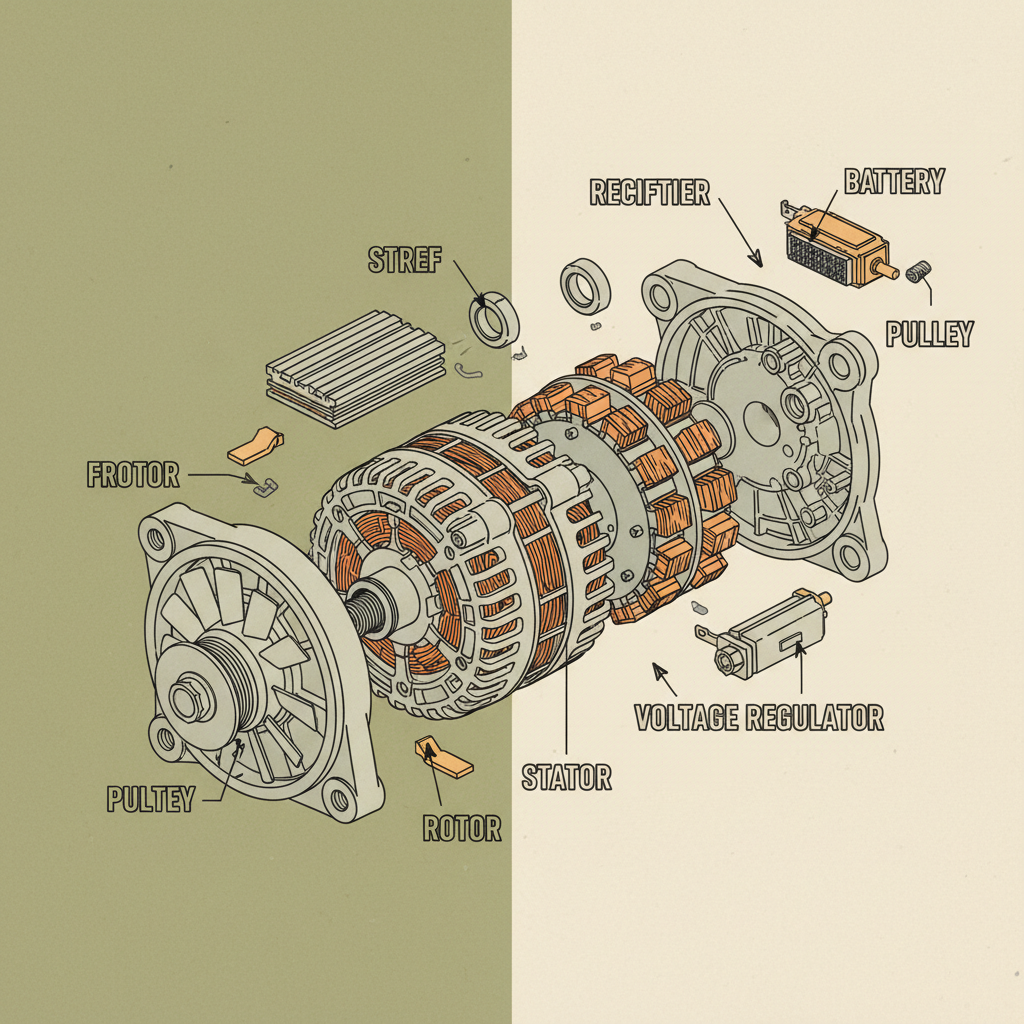
Now, about the materials. Copper windings are obviously key. The purity of the copper makes a huge difference, you can feel it. It’s heavier, conducts better. The steel laminations in the stator and rotor are also critical, you want high silicon content for minimal eddy current losses. I’ve seen some manufacturers trying to use lower-grade steel to save money, but the efficiency drops dramatically.
Then you've got the rare-earth magnets in the rotor, usually neodymium magnets. Those things are powerful! You have to be careful handling them, they can snap your fingers together if you’re not paying attention. The quality of these magnets directly affects the alternator's output. We sometimes see variations in the magnetic field strength, which can cause imbalances and vibrations. It’s a pain to troubleshoot, let me tell you.
And don’t forget the epoxy resin used to encapsulate the windings. It needs to be able to withstand high temperatures and resist moisture. Some of the cheaper resins become brittle and crack over time, leading to shorts and failures. It’s a subtle thing, but it makes a big difference in the long run.
Real-World Testing and Quality Control
Testing… that’s where things get interesting. Labs are fine for basic performance metrics, but you need to see how these things behave in the real world. We put alternators through vibration tests, temperature cycling, salt spray tests, and even drop tests. I'm not kidding about the drop tests. You've got to simulate the kind of abuse these things will take on a construction site or at sea.
We also do a lot of run-in testing. We run the alternators at full load for extended periods to identify any potential weaknesses. It’s a long, tedious process, but it’s worth it. We've caught a lot of problems that would have otherwise made it into the field.
Alternator Performance Metrics
Actual Usage Patterns of Alternators
It's funny, you design these things for a specific application, but users always find a way to surprise you. We had one customer who was using our alternators to power a mobile fish-farming operation. Fish farming! I never would have guessed. They needed a reliable power source that could withstand the harsh marine environment.
And another guy was using them to power a remote research station in the Arctic. He said the cold temperatures were a bigger challenge than anything else. Apparently, the lubricants get really thick in the cold, and the bearings can seize up. You learn something new every day.
Advantages and Disadvantages of Current Alternator Designs
Okay, let's be real. Current designs are pretty good at generating power efficiently, and they're relatively reliable. But they're also bulky, heavy, and expensive. And the maintenance… don’t even get me started on the maintenance. You’ve got brushes to replace, bearings to lubricate, and windings to inspect. It’s a constant battle against wear and tear.
One advantage, though, is that they're relatively easy to repair in the field. A skilled technician can usually get one up and running again with a few basic tools. That's important when you're dealing with remote locations or critical infrastructure.
Customization Options and Practical Examples
We do a lot of customization, actually. Last month, that small boss in Shenzhen who makes smart home devices insisted on changing the interface to . A alternator! The whole thing was ridiculous. He said it was "for future-proofing". It added a ton of cost and complexity, and it didn’t actually improve the performance at all. Later... Forget it, I won't mention it.
More seriously, we often modify the output voltage and frequency to match specific customer requirements. We also offer different enclosure options to protect the alternator from harsh environments. And we can even integrate custom monitoring and control systems. It all depends on what the customer needs.
We had a client who wanted an alternator that could operate at extremely high altitudes. They were building a communications tower on a mountaintop, and the air pressure was so low that it affected the alternator's cooling efficiency. We had to redesign the cooling system and use special materials to prevent overheating. It was a challenge, but we got it done.
Core Characteristics of Alternator Designs
| Design Feature |
Performance Impact |
Cost Consideration |
Maintenance Complexity |
| Brushless Excitation System |
Increased reliability, reduced electrical noise |
Higher initial cost |
Lower maintenance due to absence of brushes |
| Automatic Voltage Regulator (AVR) |
Stable output voltage under varying loads |
Moderate cost |
Requires periodic calibration |
| Enclosure Material (Cast Iron vs Aluminum) |
Cast iron provides better vibration damping and corrosion resistance |
Cast iron is heavier and more expensive |
Both require minimal maintenance |
| Winding Insulation Class |
Higher insulation class allows for higher operating temperatures |
Higher cost materials |
Regular inspection for degradation |
| Bearing Type (Sleeve vs Ball) |
Ball bearings offer lower friction and longer life |
Ball bearings are more expensive |
Ball bearings require periodic lubrication |
| Cooling System Design |
Efficient cooling prevents overheating and extends lifespan |
Complex designs can increase cost |
Requires regular cleaning and maintenance |
FAQS
Honestly, it's a combination of things. Temperature, vibration, load, and the quality of the materials all play a role. We've seen alternators fail prematurely due to excessive heat buildup from inadequate cooling, or because of constant vibration from a poorly mounted engine. Proper maintenance—lubrication and regular inspection—can extend lifespan significantly, but even the best maintenance can't overcome fundamentally poor design or materials.
That's a good question. First, you need to determine the power requirements of your load. Then, you need to consider the operating environment – temperature, humidity, altitude, vibration. You also need to think about the type of load—is it resistive, inductive, or capacitive? The AVR needs to be matched to the load type. And, of course, budget is always a factor. Don’t just go for the cheapest option; you’ll end up paying for it in the long run.
Listen for unusual noises – whining, grinding, or rattling. Check for voltage fluctuations or a dimming of lights. Also, look for signs of overheating, such as a burning smell or discolored components. And if the warning light on your dashboard comes on, don’t ignore it! It's a good idea to get it checked out by a qualified technician as soon as possible. The longer you wait, the more expensive the repair will be.
Yeah, definitely. We're seeing a lot of interest in permanent magnet alternators, which are more efficient and reliable than traditional brush-type alternators. There's also research into new materials for the windings and insulation, which could lead to lighter, more durable alternators. And, of course, everyone's talking about integrating alternators with energy storage systems, like batteries and supercapacitors.
It's critical. Regular inspection, lubrication, and cleaning can prevent a lot of problems down the road. Pay attention to the brushes (if your alternator has them), the bearings, and the connections. And don't forget to check the voltage regulator. A little bit of preventative maintenance can save you a lot of headaches – and money – in the long run.
That’s a bit technical, but basically, synchronous alternators rotate at a speed directly proportional to the frequency of the generated electricity. They need a DC excitation system. Asynchronous alternators, on the other hand, rely on induction from the grid to generate power. They're simpler and cheaper, but less efficient. For most applications, you'll want a synchronous alternator. I encountered a case where the wrong alternator was installed on a marine vessel; you can imagine the chaos that ensued.
Conclusion
Ultimately, we’ve covered a lot here. From the shifting landscape of pre-fabrication to the nitty-gritty details of material selection and testing, it all boils down to understanding the challenges and finding practical solutions. The key is to remember that an alternator is more than just a component; it’s a critical part of a larger system, and it needs to be designed, manufactured, and maintained with care.
And honestly? Whether this thing works or not, the worker will know the moment he tightens the screw. That's the truth of it. If it feels solid, if it runs smooth, if it does the job… then it’s a good alternator. Visit our website at www.jltalternator.com to learn more.