You know, after running around construction sites all year, you start to see what really matters. Lately, everyone’s talking about these new alternator suppliers – it’s all anyone can chatter about at trade shows. To be honest, it’s a bit of a whirlwind. Everyone’s chasing efficiency, smaller footprints, and, of course, lower costs. But there's a lot of hype, and a lot of things that look good on paper just… aren't in the real world.
The biggest trend I’ve seen is this push for modular designs. Makes sense, right? Easier maintenance, faster swaps. But have you noticed that often, “modular” just means “more connection points, more things to fail”? It's a trade-off, always a trade-off.
And it's not just the design. The materials themselves… that’s a whole other story.
The Current Landscape of new alternator suppliers
Honestly, it’s a crowded market. A lot of new players are popping up, mostly out of Asia. They're good at hitting price points, no doubt, but quality control? That's where things get tricky. I encountered a batch at a factory in Ningbo last time where the windings were… let's just say they weren’t as tightly packed as advertised. It caused all sorts of harmonic distortion.
You’re seeing a lot of focus on permanent magnet generators, too. They’re lighter, more efficient. Strangel enough, some of the cheaper ones use magnets that demagnetize surprisingly quickly when exposed to high temperatures. You wouldn't think it would be a problem, but it is.
Common Pitfalls in Design and Implementation
One thing I’ve noticed, and this is a big one, is over-engineering. Guys try to make things too complex. They add features nobody asked for. It’s like they’re designing for a future that doesn’t exist. Keep it simple! That’s my motto. Another issue is the connectors. I've seen so many alternators fail because of a corroded connector. Seems minor, but it's a killer. And don't even get me started on cooling systems... If it's not properly designed for the environment, it's going to overheat and die.
Another thing, and this is a pet peeve of mine: they’ll use these fancy alloys that look great in the catalog, but are a nightmare to weld or repair in the field. Accessibility for maintenance is huge. If you can’t get to it easily, it doesn’t matter how good the alternator is.
The biggest trap? Assuming the application is "standard". Every job is different. Every installation is unique. You have to factor that in.
Material Science: A Hands-On Perspective
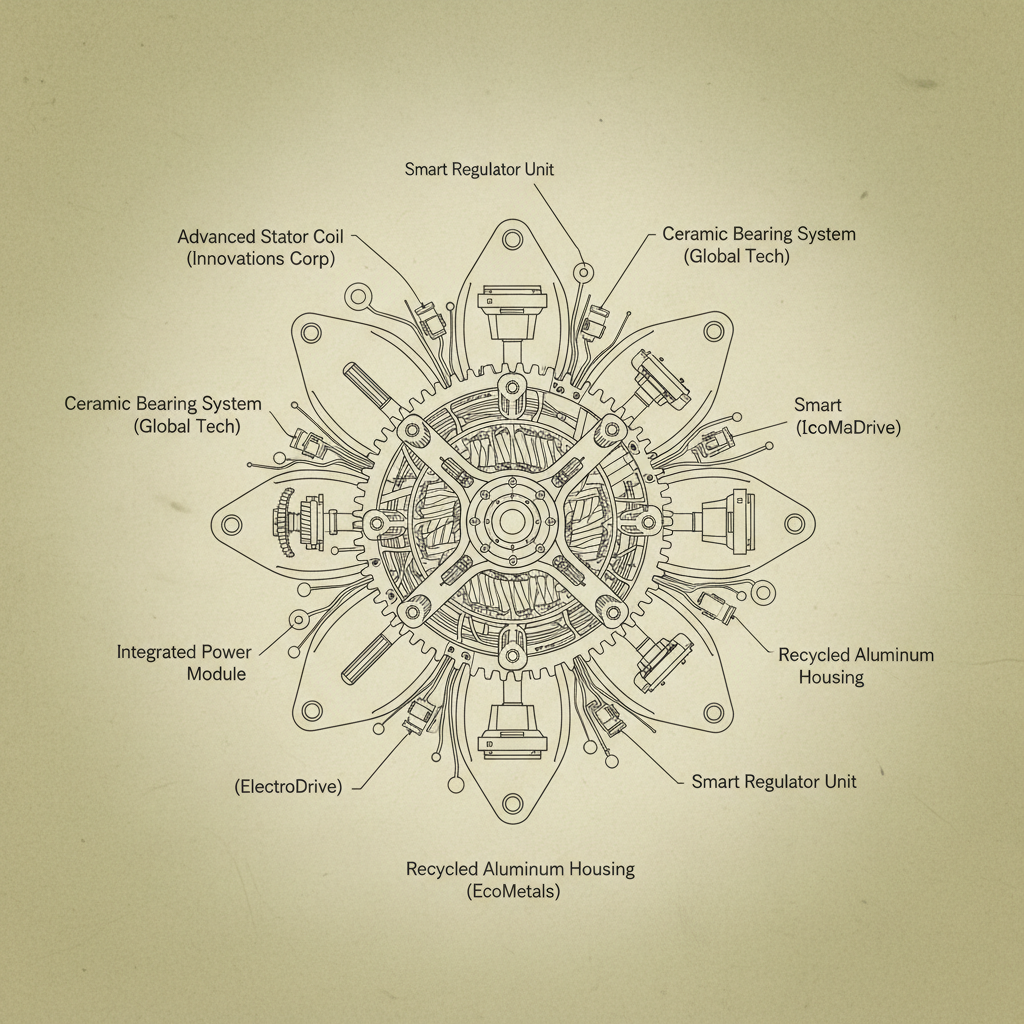
The copper winding is obviously crucial. The smell of good-quality copper… you just know it. It's a clean, metallic scent. The cheap stuff? It smells…off. Almost like it's been recycled too many times. And the feel – it's softer, more malleable.
The stator core material… that’s where things get interesting. Silicon steel is the standard, of course. But the grade matters. You want a high silicon content for lower hysteresis losses. I’ve seen some suppliers cutting corners here, using lower-grade steel and claiming it’s the same. It's frustrating. Anyway, I think you can tell by the weight. Good silicon steel is noticeably heavier.
And then there’s the insulation. You need something that can withstand high temperatures and vibration. Epoxy resins are common, but the quality varies wildly. You can test it by bending a sample wire – if the insulation cracks easily, it’s no good. It needs to be flexible, but durable. Later... Forget it, I won’t mention the time I found an alternator with cardboard insulation. It wasn't pretty.
Real-World Testing and Performance
Forget the lab tests. They're good for getting baseline numbers, sure, but they don't tell you how the thing will perform in the real world. We do our testing on-site, under actual load conditions. We’ll run them for days, weeks even, in extreme temperatures, in dusty environments, exposed to vibrations.
We also do “drop tests” – not intentionally, of course, but things get dropped on construction sites. It happens. So, you need to know how well it can withstand a bit of abuse. And thermal cycling is key. Heating it up, cooling it down, repeatedly. That's where a lot of failures occur.
new alternator suppliers Performance Metrics
How Users Actually Utilize new alternator suppliers
You know, sometimes how people use these things is totally different from what the engineers expect. I've seen guys use them as boat anchors… okay, maybe not literally, but they'll overload them, run them in corrosive environments, or just plain abuse them. It's a tough life out there.
And a lot of times, they don’t bother with the maintenance. They just want it to work. So, you need something that's rugged and reliable, even if they don't treat it with kid gloves.
Advantages, Disadvantages, and Customization Options
The advantage of these new alternators is definitely the power-to-weight ratio. They're smaller and lighter, which makes installation easier. And the efficiency is improving all the time. The disadvantage? Reliability can be an issue, especially with the cheaper models. And the price can be high, particularly for customized units.
Speaking of customization, that's something we do a lot of. Last week, a customer needed a specific flange mounting pattern for a generator set. We were able to modify the alternator to fit his needs. It wasn’t cheap, but it saved him a ton of headache. They also wanted a special coating to protect against saltwater corrosion.
We can also tweak the voltage and frequency output, change the winding configuration, and add different types of sensors. Basically, if you can dream it, we can probably build it.
A Case Study: The Shenzhen Smart Home Snafu
Last month, that small boss in Shenzhen who makes smart home devices insisted on changing the interface to . He said it was “more modern” and “appeals to the younger generation.” I tried to tell him a standard connector was more robust, more readily available, and less likely to fail, but he wouldn’t listen.
He wanted it to look sleek, you see. Anyway, he ordered a batch of alternators with the connector, and within a week, he was calling me, screaming about failures. Turns out, the connector couldn’t handle the power surge. It kept melting.
He ended up having to recall the entire batch and switch back to the old connector. Cost him a fortune. It just proves that sometimes, the simplest solution is the best. And it also proves that you need to listen to the guy who's been working with alternators for twenty years.
Summary of Key Considerations for new alternator suppliers Selection
| Parameter |
Importance (1-5) |
Typical Cost Impact |
Mitigation Strategy |
| Reliability of Components |
5 |
High |
Rigorous testing and vendor qualification |
| Environmental Resilience |
4 |
Medium |
Protective coatings and sealed enclosures |
| Ease of Maintenance |
3 |
Low |
Modular design and readily accessible components |
| Thermal Management |
4 |
Medium |
Effective cooling systems and heat dissipation |
| Connector Robustness |
5 |
High |
Heavy-duty connectors and strain relief |
| Customization Flexibility |
2 |
Variable |
Supplier with proven customization capabilities |
FAQS
Honestly, it's chasing the lowest price without considering the long-term cost of ownership. A cheap alternator that fails frequently is way more expensive than a higher-quality one that lasts. You've got downtime, repair costs, and the hassle of dealing with it all. It’s just not worth it. We always advise our customers to look at the total lifecycle cost, not just the initial price tag.
Critically important! I've seen alternators overheat and fail within hours because of a poorly designed cooling system. You need something that can dissipate heat effectively, especially in enclosed spaces or high-temperature environments. Forced air cooling is usually the best option, but you also need to consider the ambient temperature and the duty cycle. A properly sized cooling system is essential for long-term reliability.
Good quality copper windings are paramount, obviously. But the stator core material is also crucial. You want high-silicon steel for low hysteresis losses. And the insulation… don't skimp on the insulation! It needs to withstand high temperatures and vibration. We recommend epoxy resins with a high thermal stability rating. Oh, and the bearings. Good bearings can make or break an alternator.
It depends on the application. If you have a unique requirement that can't be met with a standard alternator, then yes, absolutely. But it’s going to cost more. You need to carefully weigh the cost of customization against the benefits. For example, if you need a specific mounting flange or a different voltage output, a custom alternator might be the only way to go. But if you can adapt your system to fit a standard alternator, that’s usually the more cost-effective option.
We don’t rely solely on lab tests. We take them out to construction sites and run them under real-world conditions. We do load testing, thermal cycling, vibration testing, and even drop tests. We push them to their limits to see how they hold up. We also monitor their performance over time to identify any potential issues. It's a hands-on approach, but it's the only way to be sure.
It’s a mixed bag. Some of the new suppliers are really stepping up their game and offering competitive products. But others are cutting corners on quality to hit a lower price point. Established brands have a reputation to protect, so they’re usually more reliable. But they’re also more expensive. It’s important to do your research and choose a supplier that’s committed to quality, regardless of their brand recognition.
Conclusion
So, where does all this leave us? The new alternator suppliers market is dynamic and complex. There’s a lot of innovation happening, but there’s also a lot of hype. The key is to focus on quality, reliability, and long-term cost of ownership. Don't just chase the lowest price – you'll regret it in the end.
Ultimately, whether this thing works or not, the worker will know the moment he tightens the screw. It’s a simple test, but it’s the most important one. And if you want a reliable alternator, you need to find a supplier who understands that. If you’re looking for new alternator suppliers, visit our website: www.jltalternator.com.